The Phalaborwa Rare Earths Project, located in South Africa, has a total JORC compliant Mineral Resource Estimate of 35.0 Mt at 0.44% TREO contained within phosphogypsum in two unconsolidated stacks derived from historic phosphate hard rock mining.
Rainbow’s process will deliver two products that are highly sought-after by industry: separated neodymium and praseodymium (together NdPr) oxide and a SEG+ mixed rare earth carbonate (MREC) which will include the valuable heavy rare earth elements dysprosium (Dy) and terbium (Tb), as well as a range of other commercially important rare earths, being: samarium (Sa), europium (Eu), gadolinium (Gd) and yttrium (Y). These light and heavy REE are critical components for the green energy transition, as well as being extensively used across many civilian and defence applications. They are also vital to exciting new markets, such as robotics and advanced air mobility.
The Phalaborwa updated interim economic study (Interim Study) released in December 2024 confirmed strong base line economics for the project, which has a base case NPV10 of US$611 million. Given Phalaborwa is a chemical processing operation, with its resource sitting at surface in a chemically cracked form, it has a much lower operating cost than traditional rare earth mining projects, and it is therefore estimated to be one of the highest margin rare earth projects in development today outside of China.
The Interim Study is based on a project life of 16 years, processing an average of 2.2 Mt of phosphogypsum per annum. The Interim Study envisaged the sale of separated NdPr, Dy and Tb oxides; however, since this time and further to consultation with industry, Rainbow has decided that the optimal heavy rare earth product is the SEG+ MREC noted above. Therefore the Interim Study economics do not include any value for the ancillary elements aside from Dy and Tb that will make up Phalaborwa’s SEG+ product. Of these, Y is notable as having the potential to materially impact revenue and EBITDA at today’s European prices. With an overall recovery rate of ca. 65%, the project is expected to produce ca. 1,850 tpa of NdPr separated oxides and ca. 80tpa of Dy and Tb and ca. 140tpa of Y within the SEG+ MREC.
A process flowsheet to extract rare earth elements from the phosphogypsum stacks has been developed by Rainbow and has been subject to extensive testwork. The flowsheet comprises mechanical reclamation of the gypsum, which is processed through a simple hydrometallurgical plant to recover the rare earths and produce a high grade rare earth feed stream for the solvent extraction (SX) separation process. Due to the efficiencies embedded in the Phalaborwa process via Rainbow’s IP, the flowsheet requires simpler and more cost-effective SX circuits than are the industry norm; read more about the decision to use SX for separation.
Rainbow is currently in the process of preparing a definitive feasibility study (DFS) for the project, following which financing and construction will commence, with first production expected from 2028. The project has been identified by the U.S. Government as an important contributor to REE supply chain independence, with the U.S. International Development Finance Corporation’s proposed investment of US$50 million for Phalaborwa, via TechMet, as announced at the U.N.’s Climate Change Conference, COP28.
Where we operate
Key facts
- 35.0 M/t resource estimate at 0.44% TREO
- 29% Total contained rare earth oxides
- 85% Share in the Phalaborwa project from July 2023, with option to acquire remaining 15%
Benefits
- Low Cost
- With no need for hard rock mining, crushing, and milling, the phosphogypsum will be mechanically reclaimed from the stacks and pumped into the processing facility, reducing cost per tonne compared to traditional hard rock mining.
- Cost of beneficiation expected to be significantly lower than for a mined mineral rare earth project.
- Good local infrastructure to bring consumables required for re-processing to site in a cost-efficient manner.
- Simple Processing
- Successful flowsheet to extract rare earth elements efficiently has been confirmed.
- Historical processing deposited a gypsum residue with upgraded rare earth elements in ‘cracked’ chemical form in stacks.
- Potential identified for phased development providing versatility.
- Low levels of radioactive elements when compared to typical rare earth development projects.
- Environmental Responsibility
- Processing minerals from “waste”: significant environmental benefits, by redepositing clean, benign gypsum on a new stack, in line with IFC/Equator Principles standards.
- Water neutralisation test work has confirmed the ability to treat the existing water from the stacks for reuse in a closed circuit, reducing legacy issues and overall water usage.
- Full Environmental and Social Impact Assessment workstreams underway for the DFS and permitting.
- Fewer reagents when compared to other rare earths projects.
- Sale of benign gypsum expected to allow for complete environmental rehabilitation of the site over time.
Preliminary economic assessment demonstrates robust economics
A preliminary economic assessment released in October 2022 demonstrated strong economics for the project, which is expected to have a lower capital intensity and operating cost base than traditional rare earth mining projects. The updated Interim Study released in December 2024 confirmed that the project economics remain robust despite two years of inflation totalling ca. 12% since publication of the PEA and modifications to the flowsheet.
Base case project economics as per the Interim Study1
Life of operation |
Years |
16 |
| Phosphogypsum processing | Mtpa | 2.2 |
| Production of separated magnet rare earth oxides | t | 1,865 |
| Average operating costs | US$/kg | 40.83 |
| Average EBITDA operating margin | % | 70% |
| Capital costs | US$m | 326.1 |
| Post-tax NPV10 | US$m | 610.9 |
| Post-tax IRR | % | 38 |
| Payback period | Years | 2.0 |
1 The figures in the Interim Study are based on the same basket price used in the 2022 PEA for comparability purposes (based on spot prices at that time), being US$136.20/kg Magnet REO produced based on the updated resource (US$110/kg Nd, US$112.50/kg Pr, US$340/kg Dy and US$1,875/kg Tb).
The Interim Study envisaged the sale of separated NdPr, Dy and Tb oxides. However, since this time and further to consultation with industry, Rainbow has decided that the optimal products are separated NdPr oxide and a SEG+ product, which will include all the economically important heavy REE. Therefore the numbers above do not include any value for the ancillary elements aside from Dy and Tb that will make up Phalaborwa’s SEG+ product. Of these, Y is notable as having the potential to materially impact revenue and EBITDA at today’s European prices.
Phalaborwa’s operating cost is considerably lower than traditional rare earth projects as the phosphogypsum material is already sitting at surface in a chemically cracked form, which eliminates the cost and risk of mining, hauling, crushing, grinding, flotation and cracking. This favourable profile positions Phalaborwa as one of the highest margin rare earth projects in development today outside of China, using data compiled by industry consultants Argus.
Process flowsheet development and confirmation
Historically, the extraction of rare earths from phosphogypsum has proven technically, environmentally and economically challenging. However, Rainbow has developed a process flowsheet at Phalaborwa, underpinned by comprehensive test work, which successfully delivers an overall recovery of ca. 65% of the contained rare earths. This compares very favourably to the overall recovery of separated rare earth oxides via standard processes. Importantly, the process employs standard, proven equipment and readily available reagents in a novel combination.
The leach flowsheet as published in the project PEA in October 2022 incorporated a number of processes including phosphogypsum washing, multiple stages of acid leaching, fluoride removal via CIX, rare earth precipitation, a sulphuric acid agitated bake and water leach to produce a high-grade REE stream for separation.
The leach flowsheet has been subject to an extensive programme of bench scale and pilot plant leach test work conducted both in-house and with support from Mintek (South Africa’s national mineral research organisation) at their Johannesburg facilities, aimed at supporting a DFS for the project. In addition, the Company has been carrying out a number of trade-off studies aimed at optimising capital and operating expenditure in order to arrive at the most robust project. This work has confirmed the efficacy of a much simpler flowsheet, paving the way for the first commercial recovery of magnet REE from phosphogypsum.
This diagram below shows the indicative flowsheet design:
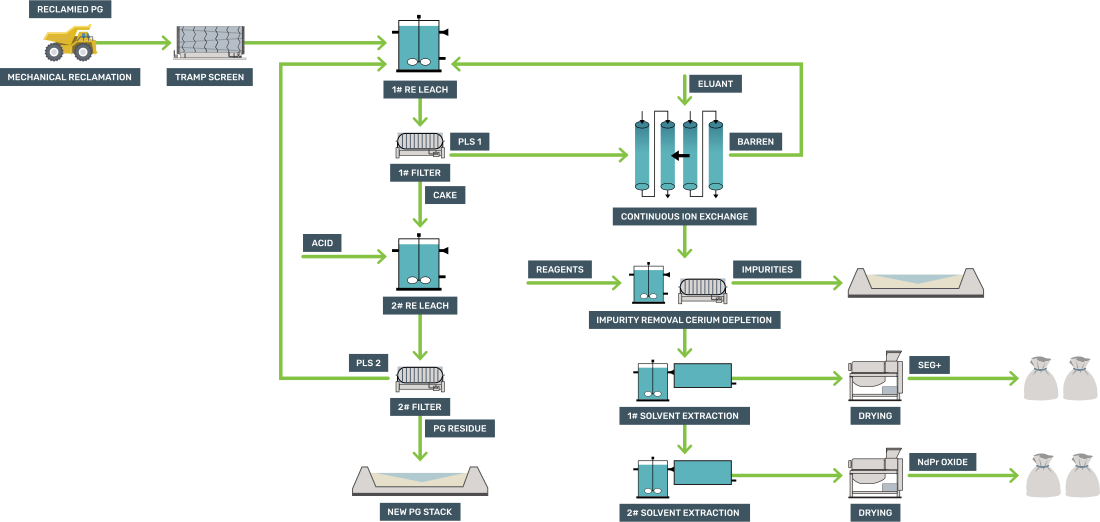
An important development for the flowsheet in 2025 was the incorporation of a purification process combining CIX and precipitation steps, as well as a cerium depletion step, that together deliver an exceptionally pure mixed rare earth feed stream for separation. This has also allowed for a significant reduction in volumetric flow from 340m3/hr to 4 – 5m3/hr feeding the separation circuit. These efficiencies via Rainbow’s IP have a major positive impact on the size, energy and reagents to be used the final SX separation circuit.
ANSTO, Australia’s world-renowned research and mineral testing institution, has been appointed to model a two-stage SX circuit required for the project to produce the planned separated NdPr oxide and SEG+ high purity mixed MREC.
The ANSTO pre-feasibility report confirms that the Phalaborwa process will only require two small SX circuits; one for the NdPr separated oxide and one for the SEG+ high purity MREC. The SX circuits will have a total of ca. 75 mixer settlers, which compares to traditional SX plants which often hold ca. 1,500 mixer settlers or more, confirming that Rainbow is maintaining a low capital intensity for the project as a whole.
The choice of SX as the final separation route allows for the finalisation of the project flowsheet and subsequent completion of the DFS. The project timetable therefore remains on track to commence construction in 2027 and first production in 2028. Whilst project development has taken longer than originally anticipated, it is still a fast-track timeline in the context of most mining and rare earth projects which can take up to 20 years or more from discovery to first operations.
Recovery of rare earths from phosphogypsum expected to be lower cost than traditional rare earth projects
With a substantially higher NdPr grade than a typical low-cost ionic clay rare earth project, Phalaborwa’s grade is closer to that of traditional hard rock style deposits.
| Project | Style | Owner | TREO 3 % |
NdPr ppm |
Uranium ppm |
Thorium ppm |
|---|---|---|---|---|---|---|
| Phalaborwa 1 | Gypsum stacks | Rainbow Rare Earths | 0.44% | 1.257 | 2 | 47 |
| Round Top 2 | Ionic Clay | US Rare Earths/TMRC | 0.063% | 39 | 45 | 179 |
| La Paz 2 | Ionic Clay | American Rare Earths | 0.047% | 80 | 1 | 7 |
| Makuutu 2 | Ionic Clay | Ionic Rare Earths | 0.08% | 232 | 10 | 30 |
| Mount Weld 2 | Hard rock | Lynas Rare Earths | 7.90% | 18,833 | 30 | 750 |
| Bear Lodge 2 | Hard rock | Rare Element Resources | 3.08% | 7,059 | 113 | 472 |
| Longonjo 2 | Hard rock | Pensana plc | 1.43% | 3,170 | 29 | 967 |
| Nolan’s Bore 2 | Hard rock | Arafura Resources | 2.60% | 6,859 | 191 | 2,700 |
| Norra Karr 2 | Hard rock | Leading Edge Materials | 0.50% | 701 | 8 | 16 |
| Lofdal 2 | Hard rock | Namibia Critical Metals | 0.32% | 181 | 18 | 350 |
1. Based on Mineral Resource Estimate announced on 20 March 2023
2. Based on public disclosure from owner
3. TREO includes Y2O3
Phalaborwa is notable as having very low levels of radioactive elements, setting it apart from typical rare earth development projects, which require complex processing to remove higher levels of radioactive elements.
Historical processing at Phalaborwa, including initial flotation by Foskor followed by further processing in Sasol’s phosphoric acid plant, deposited a gypsum residue with upgraded rare earth elements in the stacks. The phosphoric acid production process also subjected the material to sulphuric acid and heat, which led to the majority of the rare earths in the phosphogypsum material at Phalaborwa being in “cracked” chemical form which is amenable to direct acid leaching.
The economics of Phalaborwa are driven by a lower cost base as this unique project excludes many of the usual energy intensive steps associated with a traditional hard rock mining project, including:
- There is no requirement for hard rock mining, including waste stripping, which usually represents a large proportion of the cost base for a traditional hard rock mine
- The cost of hydraulic reclamation of the gypsum stacks is instead comparable to the cost of feeding a processing plant from an ore stockpile
- There is no cost associated with crushing and grinding ore, which normally forms a substantial part of the energy use and processing costs for a traditional hard rock mine
- Due to the chemically cracked nature of the REE on the gypsum stacks, Phalaborwa will not incur costs associated with producing a mineral concentrate which requires chemical cracking in a dedicated plant before feeding into a separation plant
| Typical unit processes | Typical rare earths project | Phalaborwa |
|---|---|---|
| Hard rock mining and hauling | ✓ | |
| Hydraulic transport to plant | ✓ | |
| ROM stockpile | ✓ | |
| Crushing and milling (energy) | ✓ | |
| Multi-stage flotation (energy and reagents) | ✓ | |
| Concentrate filtration | ✓ | |
| Gangue acid leaching at some projects (reagents) | ✓ | |
| Cracking (energy and reagents) | ✓ | |
| Rare earth dissolution (leaching) | ✓ | ✓ |
| Thorium and uranium removal | ✓ | |
| Impurity removal and intermediate products | ✓ | ✓ |
Phalaborwa Positive Impacts
As well as delivering products that are essential to the green energy transition, the Phalaborwa project is notable for having a number of positive impacts for both its surrounding environment and local communities.
Most importantly, the project will serve to clean up a legacy environmental issue of acid water associated with the historic unlined gypsum stacks. Rainbow will neutralise this acid water for use in the closed-circuit process plant, which is also expected to minimise the need to draw on an external water source for the processing plant. The clean-up of acid water is expected to improve groundwater quality which is impacted by the stack water emanating from the base of the unlined stacks.
Rainbow’s process flowsheet will produce a cleaner “benign” gypsum with fewer impurities which will be deposited on new stacks which are lined according to International Finance Corporation standards and Equator Principles. Rainbow has entered into a Letter of Intent for an offtake agreement with NEXUS Intertrade (Pty) Ltd (NEXUS), under which NEXUS will acquire the benign gypsum and sell it on to both the domestic and neighbouring agricultural and industrial sectors. This agreement is expected to see the stacks at Phalaborwa eventually fully depleted, allowing for the complete environmental rehabilitation of the site, as well as having a positive socio-economic effect on local industry.
Read more about our commitment to sustainable development.
An ideal location for a new operation, with excellent infrastructure
Phalaborwa is located on a brownfield site near an established mining town in South Africa, benefitting from all the associated skilled labour availability and supporting industry in place (such as the local production of sulphuric acid, which will be a key reagent for the project).
Phalaborwa is well situated from a transportation perspective, with strong rail links for the import of any specialist reagents and the export of the final product to market, as well as a local airport within a five-minute drive of the Project.
Existing infrastructure includes a high voltage switchyard (providing access to Eskom grid power), although Rainbow continues to explore options to reduce the carbon intensity of Phalaborwa’s production using renewable power.
JORC compliant measured and indicated mineral resource estimate
| Contribution of TREO by oxide | Grade ppm | ||||||||||||||
|---|---|---|---|---|---|---|---|---|---|---|---|---|---|---|---|
| Tonnes Mt | TREO % | Nd2O3 | Pr6O11 | Dy2O3 | Tb4O7 | Sm2O3 | Eu2O3 | Gd2O3 | La2O3 | Ce2O3 | Y2O3 | Th | U | ||
| Stack A | 16.0 | 0.45 | 0.106 | 0.026 | 0.0043 | 0.0014 | 0.018 | 0.004 | 0.013 | 0.078 | 0.188 | 0.010 | 47 | 1.8 | |
| Stack B | 15.2 | 0.43 | 0.099 | 0.024 | 0.0042 | 0.0013 | 0.017 | 0.003 | 0.01 | 0.074 | 0.180 | 0.010 | 46 | 1.9 | |
| Stack B Rubble | 3.8 | 0.41 | 0.096 | 0.023 | 0.0040 | 0.0013 | 0.016 | 0.003 | 0.012 | 0.071 | 0.173 | 0.009 | 41 | 2.0 | |
| Total | 35.0 | 0.44 | 0.102 | 0.025 | 0.0042 | 0.0014 | 0.017 | 0.003 | 0.013 | 0.075 | 0.183 | 0.010 | 46 | 1.8 | |
The full Phalaborwa Mineral Resource Estimation is available here.